|
Ceremonies
The Open Gorsedh
The largest ceremony performed by Gorsedh Kernow is the annual "Open Gorsedh" when new bards are admitted and competition prizes and major awards are presented.
It is performed, weather permitting, in the open, at various points across Cornwall, and the public is encouraged to attend.
The Gorsedh relies heavily on the support and co-operation of the local communities and Old Cornwall Societies to organise these ceremonies.
Bards, following robing, process to the Gorsedh site and form a large circle, at the North-eastern point of which is a platform (The Rock) on which stand the Grand Bard, the Deputy Grand Bard, the Gorsedh Secretary and delegates from the Welsh and Breton Gorsedds.
The proceedings open with a welcome from the Town Mayor or Local Dignitary, which is received and returned by the Grand Bard.
|
|
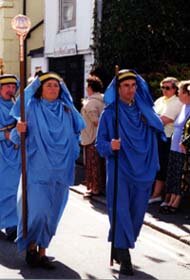
Gorsedd procession through the streets of St Columb, 2001
Click on the image for a larger version (108k)
|
|
The Gorsedh ceremony itself starts with a symbolic call to the four corners of the Nation, this being made by the Horner on the instructions of the Herald Bard.
This is followed immediately by the Gorsedh Prayer.
The ceremony of peace is then performed by the Grand Bard, who thrice asks, "Is there peace?" On the assembled Bards replying "Peace", the Gorsedh is declared open.
The "Joining of the Sword" follows now.
There is a divided sword for this part of the ceremony. One part is taken to the Rock by a representative of Brittany and the other part by a Bard from Cornwall.
The Grand Bard joins the two parts together and gives the sword to the representative from Wales. This is to show the unity between Cornwall,Wales and Brittany.
|
|
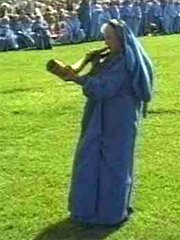
The horner calls to the four corners of the Nation
Click on the image for a larger version (72k) and for more information
|
Symbolism and Regalia
|
|
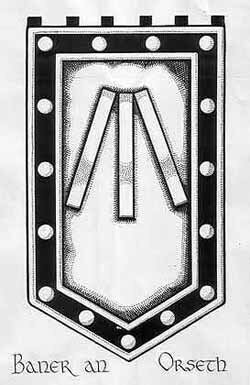
THE AWEN
Awen is a Welsh word meaning Muse or Inspiration and represents the creative powers in action.
It is also known as Y Nod Cyfrin, The Mystic Mark, or Y Nod Pelydr Goleuni, The Mark of the Shaft of Light, where it is derived from the rays of the rising sun.
In the Bardic Gorseth however, it represents the attributes of Love, Justice and Truth.
It is also a continuing symbol of the Celtic imagination which tends to express concepts in threefold form.
The Awen is the symbol of the Gorsedh or Gathering of Bards and appears for example on plastrons (breastplates).
|
|
|
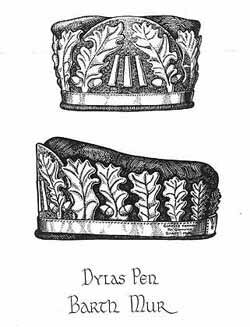
GRAND BARD’S CROWN
The current crown was made by Francis Cargeeg/Tan Dyvarow who also made the ‘second’ crown worn on the installation of a new Grand Bard.
Tan Dyvarow had a workshop for beaten copper between Hayle and Lelant.
The motif is Oak Leaves which have had a similar use in Wales, and probably date back to the Bronze Age.
The first two Cornish Grand Bards, Jenner and Nance, had a different head-dress.
|
|
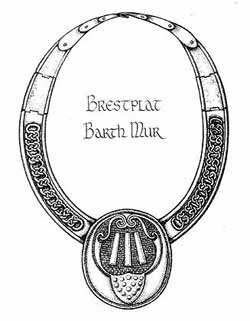
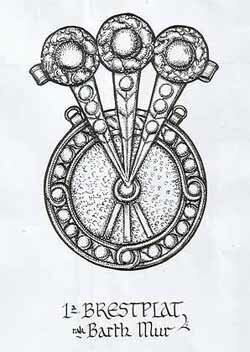
GRAND BARD’S PLASTRON
This seems to have been made about 1967.
It includes Celtic knotwork and the 15 bezant shield.
|
|
GRAND BARD’S ROBES
Until 1965 the over-robe had a Celtic design on the back and this can be seen in old pictures. The under-robe is as for other Bards except that the fold-over piece across the front is removed.
|
BARD’S ROBES
The Cornish Gorsedh has one order so all Bards are equal. The blue color is that of the sky.
Robes were first designed for bards in Wales by Professor Sir Hubert von Herkomer about 1896. Herkomer was born in Bavaria in 1849, but left Germany at age 2. Morton Nance/Mordon was a student at Herkomers Art College in Bushey, near London. In “The Cornish Review” in 1951 Nance stated he watched Herkomer making a crown, copying the bronze oak leaves from a branch of oak.
|
DEPUTY GRAND BARD
The Deputy Grand Bard has an Awen on their head-dress, where other Cornish bards have black-yellow-black bands. The plastron is the same pattern as that of the Grand Bard, and was made in 1967 by Tan Dyvarow. It is almost identical except it lacks the “scroll” pattern on the center piece.
The DGB also has a plastron for ‘civic’ use, made of Cornish Tin and presented in 1995. The parchment scroll listing deceased Bards is in a leather case presented by Ky Gwyn in 1980.
|
PAST GRAND BARDS
Former Grand Bards are easily spotted in their bright yellow head-dress with an Awen in front.
This seems to date back to 1966, and also from then the immediate Past GB has worn Mordon’s original plastron.
Other Past GBs plastrons are made to a 1970 design.
|
|
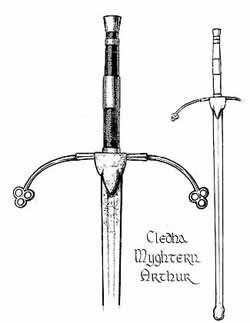
SWORD
The current sword was purchased in 1947 and repaired in 1978. It symbolises the sword of Arthur, a once and future King of the Britons.
The original sword dating back to 1928 is not in good condition.
|
|
SWORD BEARER
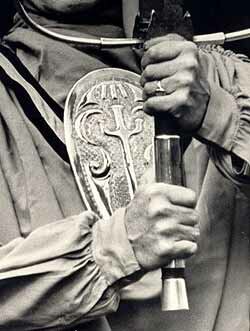
The original Sword Bearer’s plastron was ‘lost’ from a car belonging to Ky Gwyn in Bristol in 1978. This followed a visit to Wales by Map Dyvroeth and Gwas Costentyn. The Gorsedh would be grateful to know of its whereabouts.
Tan Dyvarow once said this was “the best piece of regalia he had ever made” and it is perhaps as well he died before it was lost, thus sparing him the anguish.
|
|
|
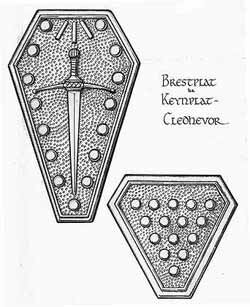
The replacement regalia for the Sword Bearer was made by John Turner of Newquay/Towan Porth Lystry in 1978/9.
They show a sword, 15 bezants and the Awen.
|
|
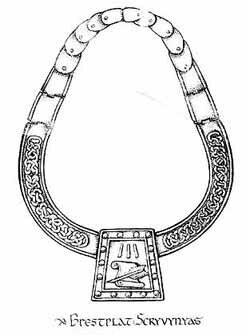
SECRETARY’S PLASTRON or BREAST-PLATE
The Secretary’s plastron was made by Tan Dyvarow in 1967. It was commissioned by Gwrek Map Melyn after Map Melyn died.
Appropriately it includes a quill pen (nowadays a computer is used), the Awen and Celtic knot-work.
|
|
ADMISSIONS SECRETARY
The admissions Secretary administers the admission of New Bards. The plastron is similar to that of the Secretary, but smaller. It is in fact the original Secretary’s plastron, worn for many years by Map Melyn.
|
TREASURER’S PLASTRON
This is a small square of copper on a leather neck strap. It was made in 1998. There are 15 bezants around the edge with a picture of a "purse" or drawstring bag. On either side there are piles of coins, and above the purse there is the Gorsedh Awen symbol.
|
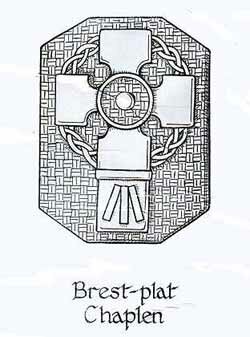
CHAPLAIN’S PLASTRON
This was made in 1984 by Cyril Orchard of Penzance, and is mounted on wood. The design is a type of Celtic Cross.
|
|
HERALD BARD
The Herald Bard’s wand of office follows medieval practice and is made of peeled willow. It is 24 inches long and is surmounted by the Awen. It was commissioned in 1976.
|
LADY OF CORNWALL ROBES (AT OPEN GORSEDH)
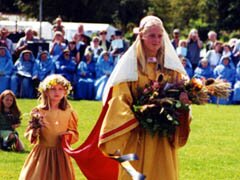
These were designed in 1933. The present robes were made by John Jenkin’s late wife and first used at Roche in 1991. Those used from 1928 to 1933 were different.
Originally the Lady was accompanied by two page boys who wore yellow/buff tabards with a black chough on the front.
|
LADY OF FLOWERS (at Proclamations)
The robes are the same as above.
|
THE DANCERS
Talek introduced these - from Wales - when he was Grand Bard. The first performance in Wales was in 1936 at Machynlleth, and was created and choreographed by Cynan. From 1954 it took place on stage at the crowning and chairing.
|
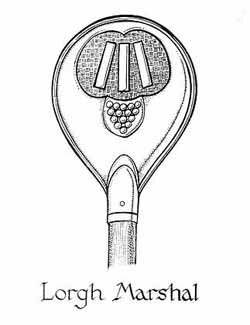
MARSHALL’S STAVES
The staves are made of hardwood with repoused heads bearing the Awen symbol. They are some 6 feet long by 1¼ inches in diameter (1830mm by 30.5 mm). They were made by Tan Dyvarow about 1967.
Morgarer remembers using them in 1968 at St Just when he was deputy to Den Delynyans.
In 1994, with Gorsedh Council approval, three small copper plaques (1¼ inches by 1 inch) were attached to the Marshall’s Staff to commemorate previous Marshals.
The plaques were engraved as follows:-
Map Kenwyn 1946-1967, Den Delynyans 1968-1979, Morgarer 1980-1990. Map Elmet 1991-1997 has been attached to the stave also, by Colin Ellis.
|
|
INSTRUMENTS: THE HARP
For several years the harpist has used her own harp. The Gorsedh owns a smaller harp named after John Legonna. An older Harp built in 1830 was sold in 1989.
|
INSTRUMENTS: THE HORN
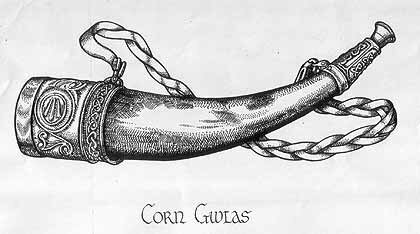
This is a genuine Buffalo horn with detailed filigree work added by Tan Dyvarow in 1940. It has a baritone mouthpiece. An unsuccessful attempt was made to use a trumpet in earlier Gorsedhow. The trumpet was sold in 1946.
|
THE BARDIC CHAIR
This was designed and made by Pengover and first used at the 1983 Gorsedh. A cushion presented by the Cornish Guild of Spinners, Weavers and Dyers was first used at the 1990 Gorsedh in Marazion. Between the annual Gorsedh ceremonies it can be seen in Truro Cathedral. The name of every Grand Bard since 1928 is inscribed on the chair. The Cornish inscription AN GWYR ERBYN AN BYS translated from Welsh (Y gwir yn erbyn y byd) means in English "The Truth against the World".
|
THE HALF SWORD
The Gorsedh's new sword is used in the ceremony for the Joining of the Sword, a symbol of the uniting of the three Celtic nations, and the two halves are carried by Cornish and Breton Bards to the Grand Bard who passes the united sword to the representative of the Welsh Mother Gorsedd as a symbol of unity and friendship.
The handle of the nickel plated sword was fashioned from yew wood from the St Columb Churchyard, a fitting tribute to the first Grand Bard, Henry Jenner who was from the town. Engraved on the blade are the words "lymm ow lown heb own a boon" the Cornish for "sharp my blade without fear of pain" taken from a poem by Tim Saunders - Bardh an Werin.
The sword was made by Mr Colin Rescorla of St Columb in 2010.
|